

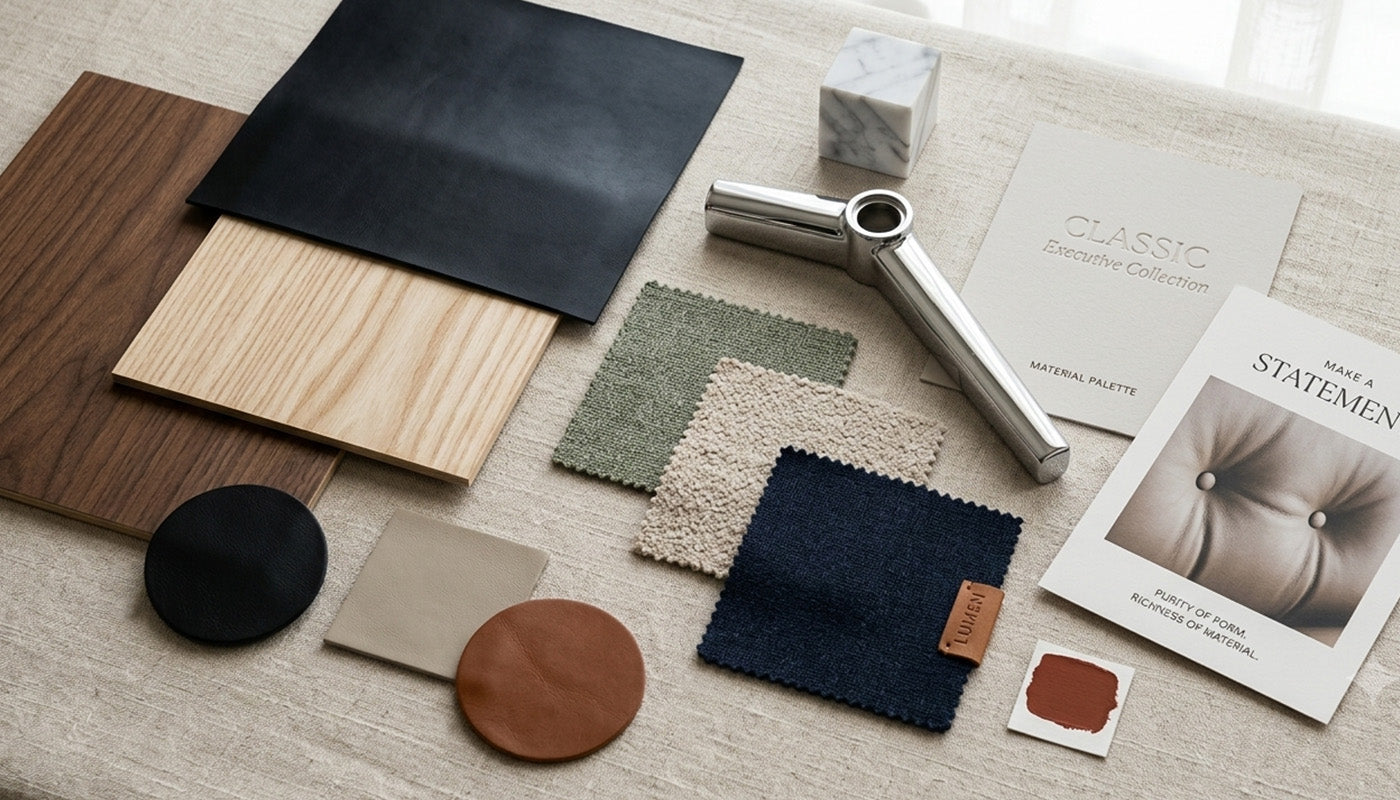



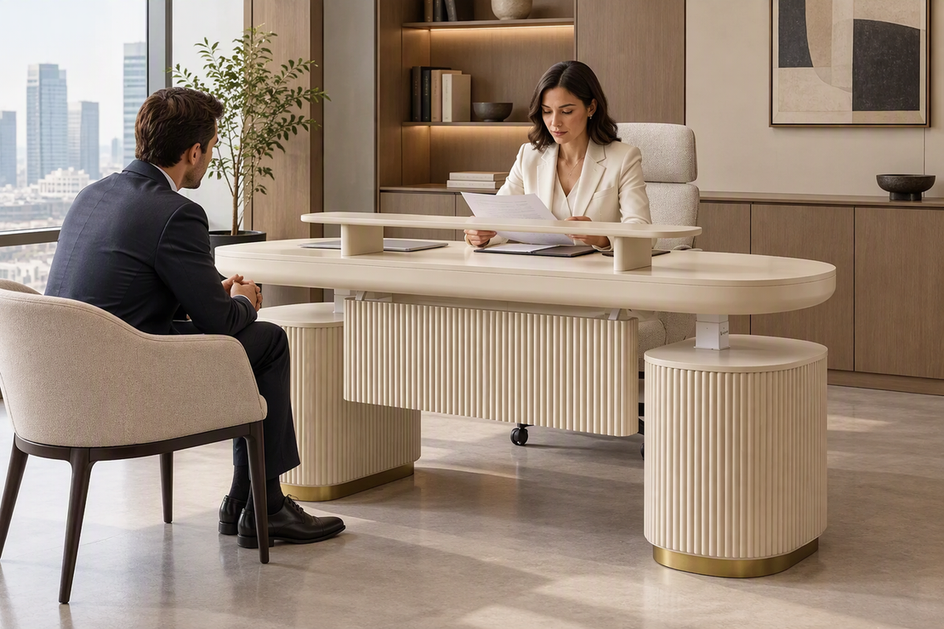
No single material wins across every corporate desktop scenario. Laminate can be the strongest candidate for high-contact shared workstations, but only once its exact surface type, core, and edge construction are documented. Veneer and solid wood stay in play for executive offices, boardrooms, and reception areas where natural appearance is a defined requirement, provided the finish and care expectations are accepted upfront.
The right choice depends on how a desk will be used, not on which material sounds more premium. In corporate desktop projects, evaluating the variables that actually change a purchase order—surface exposure, spill risk, edge construction, maintenance, and cost per square foot—prevents costly specification mistakes.
The Fastest Corporate Desktop Material Shortlist
Use this table as a starting filter, not a final ranking. Universal scratch, water-ring, and cost-per-square-foot numbers are not supported across all three materials, so treat each cell as a construction cue rather than a guaranteed result.

| Material | Construction Cue | Cost Status | Scratch/Water Exposure | Edge & Maintenance Notes |
|---|---|---|---|---|
| Laminate | Decorative layer over a substrate; type varies (HPDL vs. lower-pressure/TFL) | Varies by laminate grade and edge spec; request a quote | Depends on laminate grade and finish, not the "laminate" label alone | Edge material/attachment must be specified separately; cleaning needs match the finish |
| Solid wood | Full-thickness wood; finish and species vary | Varies by species, finish, and joinery; request a quote | Finished wood resists moisture reasonably but still needs prompt drying and impact care | Edge is part of the solid stock, but attachment and corner detail still need confirmation |
| Veneer | Thin wood face over a core (often manufactured wood) | Varies by core, veneer grade, and edge treatment; request a quote | Performance depends on the core and finish, not the wood face alone | Veneer edgebanding is a separate spec line from the face material |
For shared workstations, treat laminate as the first candidate only after confirming its laminate type, core, thickness, finish, and edge. For executive offices, boardrooms, and reception, veneer or solid wood remain reasonable when appearance is a stated requirement, not proof of durability. For large rollouts, prioritize repeatable specifications, comparable quote scope, and written delivery terms over any single material's reputation.
Laminate: A Surface Specification, Not a Universal Durability Rating
Laminate is a category name, not one product. High-pressure decorative laminate (HPDL) and lower-pressure types such as thermally fused laminate (TFL) are different constructions with different durability profiles, so the word "laminate" alone tells a buyer very little.
Before approving laminate for a multi-desk order, get the supplier's exact laminate designation, the substrate underneath it, the finish, and the edge assembly in writing. A vendor's scratch-resistance or easy-clean claim applies to that specific product, not to every laminate desktop on the market. The useful procurement output is a complete, repeatable specification your facilities team can apply across every desk in the project, not a generic laminate label on a purchase order.
Solid Wood: Natural Construction With Moisture and Humidity Variables
Solid wood fits a corporate project when natural-wood construction is a stated design requirement and the team accepts the care that finished wood needs. Properly finished architectural woodwork resists moisture reasonably well, but it still requires prompt drying after spills, non-abrasive and non-ammonia cleaning, protection from repetitive impact, and reasonably controlled humidity to limit wood movement, according to finished wood care guidance.
That care requirement is the real trade-off, not an automatic ranking over laminate or veneer. Choose solid wood because the appearance and feel are a defined project requirement, and confirm the species, finish, thickness, and edge treatment in the quote before ordering.
Veneer: Executive Appearance Depends on the Core, Finish, and Edge
A veneer desktop is not the same as a solid-wood desktop. The visible wood layer sits on a separate core, and that core, along with the finish and edge, determines how the desk actually performs. Veneer fits appearance-led executive, boardroom, or reception specifications once the core and finish are confirmed and the facilities team accepts the same care expectations that apply to finished wood.
The exact product record matters here. Our Opal birch veneer desk lists birch solid wood veneer over manufactured wood for some top options, while other variants of the same listing use a sintered stone top over manufactured wood instead. That difference shows why a buyer has to match the selected variant, not the product name, before comparing it against another material. Never assume every desk in a veneer-labeled line shares one construction.
Scratch Resistance: Separate the Surface Claim From the Whole Desk
Scratch exposure comes from the finish and surface construction, not from the material category printed on a spec sheet. A specific laminate grade, wood finish, or veneer topcoat can carry a manufacturer scratch or wear claim, but that claim covers the tested product and finish, not every desk built from the same base material.
For high-contact shared workstations, ask the supplier for the exact surface documentation of the model you are specifying, along with the expected cleaning routine. Without a documented test or construction detail for your specific desk, there is no defensible way to rank laminate, solid wood, and veneer against each other on scratch resistance alone.
Water Rings and Spills: The Decision Is Cleanup Exposure, Not a Simple Material Ranking
Water-ring vulnerability depends on the finish, how long liquid sits on the surface, and how quickly someone wipes it up, not on the material name by itself. No desktop material is completely ring-proof without prompt maintenance, and liquid tolerance varies widely depending on the protective topcoat and joinery.
For finished wood-based tops, keep the surface out of direct contact with standing moisture and dry any spill immediately, per the same finished wood care guidance that governs general maintenance. In break rooms, shared desks, or any area with inconsistent spill response, require a documented surface finish and a written cleanup expectation before approving the material, rather than trusting the material label to protect the desk.
Edge-Banding Durability: Specify the Joint Before Comparing Materials
Edge durability is a separate specification from the desktop face, and it needs its own documentation before any material comparison is meaningful. Architectural woodwork guidance distinguishes several edge methods, including veneer edgebanding, inset solid-wood edgebanding, and applied solid-wood edging, and calls for exact material selection and fabrication detail at the edgebanding specification level, including the bottom edge treatment.
For desks with exposed or heavily handled edges, a missing edge spec is a gap in the order, not permission to assume one edge method outlasts another. Require the edge material, attachment method, thickness, and corner treatment on the quote or shop drawing for every desk in the project. Procurement teams can also request applicable ANSI/BIFMA surface standards documentation for cleaning and durability testing, though a standards listing confirms available documentation, not a three-way material ranking.
Maintenance: Match the Finish to the Cleaning Routine
The right maintenance plan follows the finish, not the material category. Finished woodwork care rules out abrasive pads, harsh chemicals, and ammonia-based cleaners, and calls for prompt moisture removal to protect the surface over time, per the same finished wood care source cited above.
Before standardizing a cleaning program across a multi-desk order, request the model-specific care instructions for the exact laminate, wood, or veneer finish you selected, and weigh that routine against your facility's expected impact and humidity exposure. A cleaning product that works safely on one finish can damage another, so treat maintenance as a per-model confirmation step rather than a generic office-wide policy.
Cost per Square Foot: Use a Quote-Based Comparison, Not an Invented Ranking
There is no verified price list that ranks laminate, solid wood, and veneer by cost per square foot, so the only defensible method is to calculate it from your own comparable quotes. The formula is simple: divide the comparable quoted scope in dollars by the included desktop area in square feet.
For illustration only, an $16,800 quote covering 8 desks with a combined 140 square feet of desktop area works out to $120 per square foot ($16,800 ÷ 140 sq ft). That number has no meaning outside this hypothetical scope. Before running your own math, confirm that every competing quote includes or excludes the same items: desktop face, core, edge, base, delivery, and installation. Comparing a top-only laminate price against a fully delivered and installed veneer desk will produce a misleading number even if the arithmetic is correct.

Commercial Shipping and Returns: Put Project Terms in Writing
Material selection does not resolve delivery or return risk on a multi-desk order, so treat procurement terms as a separate checklist. Start by requesting a written project order that states the freight mode, receiving point, and whether inside delivery, assembly, installation, and debris removal are included, since large or palletized orders may ship via LTL freight and standard service typically ends at an accessible dock, loading area, or curb unless an upgraded service is expressly purchased, according to our commercial shipping policy.
Also confirm receiving windows, inspection steps, damage-reporting timelines, and cancellation terms before the order ships. Our posted refund policy describes a 30-day return window in original condition, customer-paid return shipping, and a restocking fee for direct online purchases, but that language is specific to that retail channel. Commercial, custom, or project orders need their own written cancellation, return, and refund terms confirmed before you place the purchase order, since the online policy does not automatically extend to those orders.
Material-to-Scenario Decision Path
For shared workstations, approve laminate only once the exact laminate type, core, finish, edge, and expected cleaning routine match your traffic and spill exposure; if that documentation is incomplete, request it before ordering rather than assuming any laminate will hold up. For executive offices, boardrooms, or reception areas, approve veneer or solid wood only when natural appearance is a defined requirement and your team accepts the finish, edge, and care obligations that come with it; if appearance is not a stated priority, a well-documented laminate may serve the space just as well at lower risk.
For large projects or desks with exposed edges, hold approval until you have a comparable dollars-per-square-foot figure built from matching quote scope, a written edge specification, and confirmed receiving and return terms for the project order. When all four line up, material, construction, cost, and procurement terms, you have a defensible specification rather than a guess based on a material name. If any one piece is missing, ask your supplier for a model-matched specification and written quote before moving forward.
FAQs
What should a facilities team document when a desktop edge is damaged?
Record the face material, edge material, attachment method, finish, dimensions, and the exact model or variant before requesting a repair or replacement. Edge assemblies vary even within one product line, so confirm matching availability with the supplier in writing rather than assuming any edge treatment is interchangeable with what is currently installed.
How do procurement teams prevent quote scope mismatches when comparing top materials?
List the required inclusions explicitly on the request for quote before calculating dollars per square foot. Verify that each bidder accounts for the identical scope, such as the top substrate, edgebanding application, mounting hardware, freight delivery tier, and on-site assembly, rather than comparing a bare desktop slab to an installed work surface.
Can facility cleaning crews use standard commercial disinfectants on veneer and solid wood tops?
Review the specific manufacturer finish guidelines prior to applying general office sanitizers. Architectural woodwork guidance advises against ammonia-based agents, abrasive pads, and harsh chemicals, meaning wood and veneer tops require non-abrasive, finish-approved cleaning routines to prevent premature surface degradation.


Leave a comment
This site is protected by hCaptcha and the hCaptcha Privacy Policy and Terms of Service apply.